
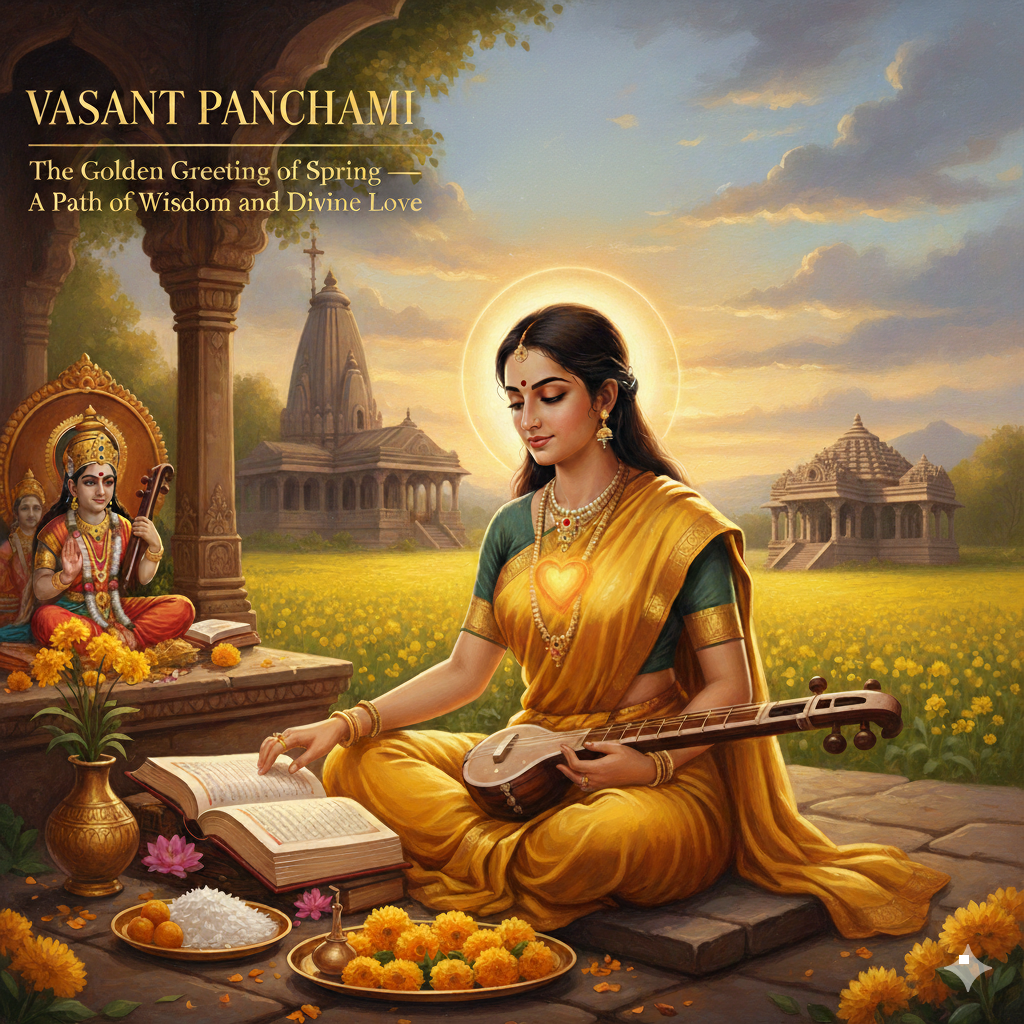

Vasant Panchami: The golden greeting of spring
·
Vasant Panchami
It is that time of year again when nature is dressed in delicate yellow and the wind whispers stories of wisdom and new beginnings. Have you ever felt the quiet, promising signs of spring in the Indian lunar calendar? Vasant Panchami, the day on which Saraswati, the goddess of wisdom, arts and sciences, is especially revered, calls us to pause, listen and attune ourselves to the light of knowledge.
The roots of the words reveal the transition from the hidden to the visible.
Vasant (वसन्त):
Derived from the root “vas” (to shine, to dwell, to clothe).
Meaning: The time when the world “dresses” itself anew or when light “dwells” in matter again. It is the moment when warmth calls life back.
Panchami (पञ्चमी):
Derived from “pañca” (five).
Meaning: The fifth tithi (moon day) of the bright half of the month of Magha. In Vedic tradition, the number five often represents the five elements (Pancha Mahabhutas), which rearrange and harmonise themselves in spring.
Saraswati (सरस्वती):
From “saras” (river, water, flowing) and “vati” (possessing).
Meaning: “The flowing one”. In Nirukta, it refers to the energy that brings consciousness from stagnation into flow – be it as a river, as language (Vāc) or as knowledge.
Mythological analysis
Myths are not stories of the past, but processes that take place in the space of your consciousness.
The birth of language:
Brahmā created the universe, but found it too quiet and lifeless. He sprinkled water into the air, from which Saraswati appeared with her vina (lute).
Essence: Without vibration and knowledge, matter remains silent. Vasant Panchami celebrates the first breath of inspiration.
Awakening from rigidity:
The myth says that on this day, knowledge (Saraswati) frees the world from ignorance (winter sleep).
Symbolism: The yellow colour that dominates on this day represents the light of the sun and the ripening of the mustard seed – a symbol of the fertility of the mind.
Kama Deva’s return:
In some traditions, this is when preparations begin for the return of Kamadeva (god of love), who rekindles passion and the desire for life.
Ethnological analysis
How the cosmic order manifests itself in human culture and in the rhythm of the earth.
Vidyarambha (beginning of learning):
Traditionally, this is the day when children write their first letters. It is the foundation stone for personal “cultural development”.
Yellow aesthetics (Basant):
People wear yellow (Pitambara), eat yellow foods (saffron rice) and offer yellow flowers.
Ethnological background: It reflects the blooming mustard fields of northern India and marks the socio-economic transition to harvest time.
Kite flying and folk songs:
In Punjab in particular, kite flying symbolises the ascent of the spirit into the freedom of the sky after lingering on the ground during winter.
Vasant Panchami is thus an invitation to rediscover one’s own “voice” – that point where the silence of winter transitions into the creative rhythm of life.
What does it mean to truly honour wisdom on this day – and how can we carry it into our lives?
Vasant Panchami: The golden greeting of spring
Vasant Panchami, also known as Saraswati Puja, falls on the fifth day of the month of Magha in the Indian lunar calendar. The day marks the beginning of spring, Vasant meaning spring and Panchami meaning the fifth day. The fields and temples glow in yellow, the colour of enlightenment and joy, which is also worn by the goddess herself. Yellow symbolises energy, clarity and the awakening of nature – all signs of a new beginning that can take place both externally and internally.
In the Vedic tradition, Vasant Panchami is a day when students, artists and scholars clean and bless their books, musical instruments and tools in order to receive wisdom and creativity. It is a day that celebrates learning, teaching and expression, while also honouring nature itself, which begins to blossom again after the cold months of winter.
Spiritual dimension: Saraswati and the inner temple and kingdom of heaven within human beings
Saraswati, the goddess of wisdom, is often depicted with a veena, a musical instrument that symbolises harmony and creativity, and a book that represents knowledge and learning. In her four hands, she holds virtues: the attainment of knowledge, purity of mind, artistry and spiritual enlightenment.
Spiritually speaking, Vasant Panchami invites us to purify our inner temple of wisdom:
Wearing yellow: Symbolises not only light and knowledge, but also the inner warmth and joy that enlivens learning.
Meditation and self-reflection: A moment of silence in the morning to organise one’s thoughts and open the mind to knowledge.
Honouring the arts: Music, writing, painting or other creative activities as a form of worship and self-expression.
As Ramana Maharshi said, “True wisdom can only be experienced through the silence of the heart.” Vasant Panchami is a day when you consciously enter into this silence.
Rituals and practical examples
Breakfast with yellow: Traditionally, rice dishes, desserts or drinks with saffron or turmeric are prepared on Vasant Panchami. Yellow, as the colour of light and the sun, strengthens the energy of life.
Blessing books and instruments: A ritual cleansing and placing of learning and musical instruments on the altar, accompanied by prayers for wisdom.
Flower offerings: Yellow flowers – such as marigolds or mustard flowers – are offered as symbols of nature, the sun and life force.
Artistic expression: Draw, write or make music consciously on this day; every creative act can be seen as a tribute to Saraswati.
Vasant Panchami in contemporary Indian life
Even though we do not all visit temples or perform traditional rituals on a daily basis today, Vasant Panchami can serve as a symbol of new beginnings and conscious openness to knowledge:
Start a new project or field of study.
Open yourself to creative ideas or spiritual studies.
Pay attention to and be grateful for nature, especially the first signs of spring.
Connect with other people to share knowledge, art and inspiration.
As Aurobindo said: “Light, power and beauty – these are the three ways to realise wisdom.” Vasant Panchami invites you to walk this path, at your own pace, with an open heart and a clear mind.
Vasant Panchami is more than a day on the calendar – it is a celebration of wisdom, the arts and spring. Yellow illuminates our minds, Saraswati inspires our learning and nature reminds us of new beginnings. Whether through meditation, creative practice or the blessing of tools of knowledge, this day offers an invitation: open your heart to wisdom, honour the arts and blossom with nature.
Interpretation from a Christian perspective
There comes a time of year when the soul recognises the first rays of light, and the wind whispers like a quiet invitation: open your heart. Can you feel the world awakening around you, nature weaving its colours anew? On days like these, when the light of the sun grows stronger, the Holy Spirit invites us to open our inner eyes, to feel Christ consciousness and to renew our relationship with God.
Spring in the heart: a day of light
Just as nature sheds winter, so too does the spirit call for renewal. This special day – which we celebrate not only on the calendar but in our hearts – is a day of learning, wisdom and inner creativity. Like the Holy Spirit, who fills us with his gifts, this day encourages us to cast off the veils of habit and see life with new eyes.
Wear yellow, the colour of light, as an outward sign of inner awakening. Yellow is not only joy, it is clarity and the life force that connects us through the Christ within ourselves.
Awakening Christ consciousness
Christ teaches us that wisdom and love go hand in hand. This day invites us to purify the inner temple of the soul:
Meditation in the light: Let the silence speak to you, open your heart to the wisdom that only the Holy Spirit can give.
Honour the arts: Every creative act – be it music, writing or painting – is an expression of divine love. When you are creative, you enter the field of Christ consciousness.
Blessing of the tools of the spirit: Books, musical instruments, tools of your trade – they can all become channels of divine inspiration when you bless them consciously and mindfully and use them with gratitude.
As Jesus said, “The kingdom of God is within you.” This day reminds us that wisdom, love and inspiration begin in the silence of the heart.
Rituals of renewal
Meal of light: Start the day with a breakfast that invigorates your senses. Yellow fruits, golden foods – a small celebration of the life that God gives. This can also take place in a group as an “agape”. The agape is a simple, profound meal of love that connects community, presence and spirit. It thrives on attitude, not form, and opens a space in which Christ consciousness, humanity and peace can be experienced. Those who host an agape do not create an occasion – but a place of love.
Blessing ritual for knowledge and creativity:
Clean and organise your books, instruments or tools. Say a word of thanks, ask the Holy Spirit for guidance.
Art as prayer: Sing, write, paint – everything can become a sacred practice, an expression of God’s love in you and through you.
Connection with nature: Be conscious in the world, see the life force that God has created in everything, and open yourself to His presence.
Vasant Panchami revisited:
Awakening through the Holy Spirit
Even without a temple or ritual, this day can become an experience of the Holy Spirit. Open yourself to inspiration, creativity and wisdom. Begin something new, heal yourself and your relationships, recognise the Christ consciousness in yourself and others. Just as spring renews the earth, the Holy Spirit renews our soul, our relationship with God and our ability to bring love and light into the world.
As Master Jesus said: “Come unto me, all ye that labour and are heavy laden, and I will give you rest.” In silence, devotion and conscious action, this day becomes a celebration of divine closeness.
Vasant Panchami, understood anew in the light of Christ, becomes a day of inner awakening: the mind opens to wisdom, the heart to love, the hands to creativity. Yellow, light and inspiration become symbols of Christ consciousness. Through the experience of the Holy Spirit through the depth of meditation and prayer, we renew our relationship with God and bring light into the world.
joachim-nusch.de
Jyotir-Vidya
jyotishi de
jyothibhoomi.com